
Focus
GLAFO addresses key scientific challenges in understanding and modelling land–atmosphere feedbacks across a range of spatial and temporal scales. The initiative focuses on quantifying the coupled processes linking soil, vegetation, and the atmospheric boundary layer, with particular emphasis on energy and water exchange, turbulence, and transport processes emphasis on energy and water exchange, turbulence, and transport processes. emphasis on energy and water exchange, turbulence, and transport processes.
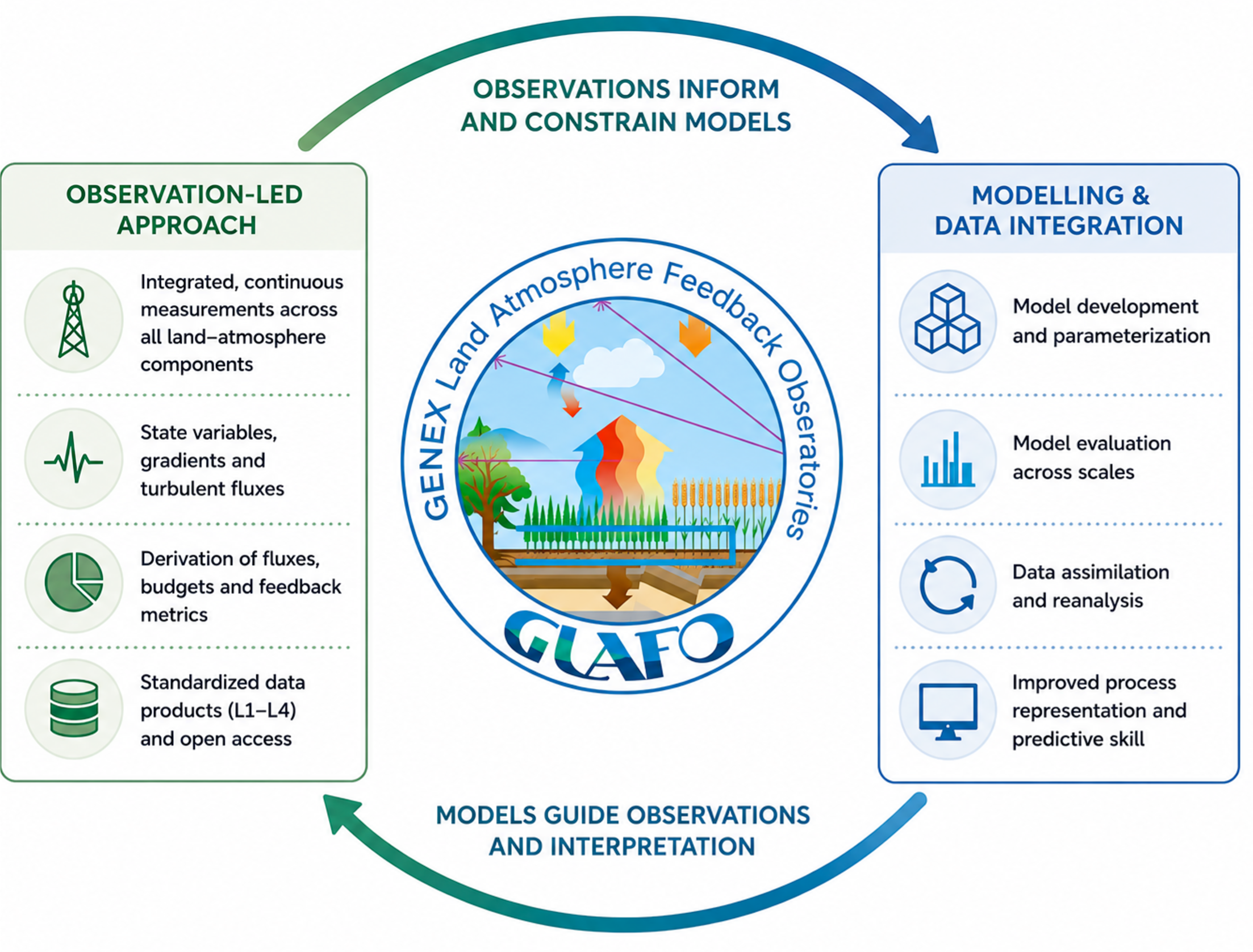
To achieve this, GLAFO adopts an observation-led approach tightly integrated with modelling, enabling improved process understanding and more accurate weather and climate predictions.
Scientific Objectives
- Quantify land–atmosphere (L–A) feedbacks across diverse climate regimes
- Characterise transport and exchange processes across the soil–vegetation–atmosphere continuum
- Improve the representation of surface fluxes, vegetation processes, and atmospheric turbulence in Earth system models
- Assess the impact of land-use and land-cover change on weather and climate
- Support the development of climate mitigation and adaptation strategies
Observation-Driven Approach
GLAFO adopts an observation-driven approach based on continuous, integrated measurements across all components of the land–atmosphere system. This includes:
- Simultaneous observations of state variables, gradients, and turbulent fluxes
- High temporal and spatial resolution measurements from diurnal to seasonal scales
- Sensor synergy, combining in situ and remote sensing systems
This enables the direct derivation of fluxes, budgets, and feedback metrics, providing a process-based understanding of L–A interactions.
Integration with Modelling
GLAFO is designed to directly support model development and evaluation. The resulting data products will:
- Improve and constrain model parameterisations
- Enable rigorous evaluation of weather and climate models across scales
- Support data assimilation and advanced reanalysis
This establishes a continuous feedback loop between observations and modelling, advancing process-level understanding of L-A interactions and improving the representation of these processes in weather and climate models.
Global Scientific Framework
Through a coordinated network of observatories and standardised data products, GLAFO enables consistent comparison across sites and climate regimes. This supports the development of robust, transferable understanding of land–atmosphere processes.