
Instrumentation
GLAFO observatories provide continuous, high-resolution measurements across the land–atmosphere system through the integrated use of complementary measurement technologies.
An Integrated Measurement Framework
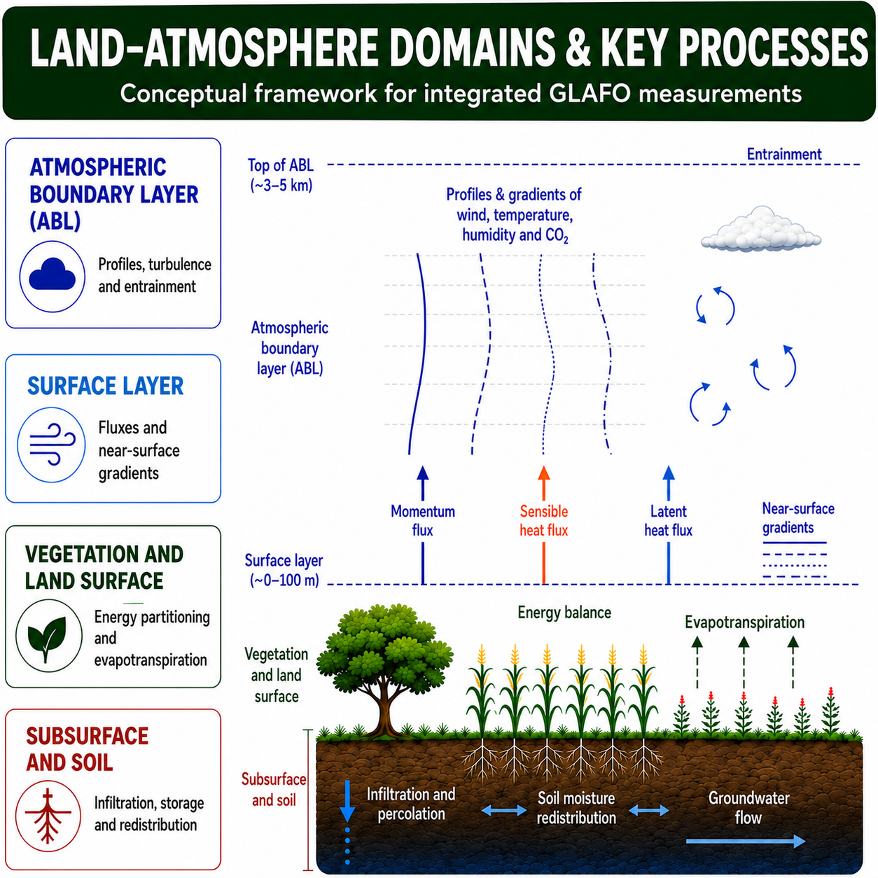
GLAFO combines in situ and remote sensing systems to capture the key processes governing land–atmosphere interactions across all domains. These include the subsurface and soil, the vegetation and land surface, the surface layer, and the atmospheric boundary layer. Together, these domains form a continuous, vertically coupled system, as illustrated in Figure 1.
Defining Characteristics of a GLAFO
A GLAFO is defined not only by the presence of individual instruments, but by the way measurements are designed, coordinated, and sustained across the land–atmosphere system. Key characteristics include:
- Dedicated long-term measurements that capture variability from diurnal to seasonal and climatological timescales.
- Sensor synergy, in which complementary in situ and remote sensing systems operate together to resolve coupled processes.
- Simultaneous profiling and observation across domains, linking subsurface, vegetation and land-surface, surface-layer, and atmospheric boundary-layer measurements.
- Inclusion of subsurface observations, recognising the role of soil moisture, temperature, and groundwater in land–atmosphere feedbacks.
- Standardised observational configurations and data structures, enabling comparability across sites and supporting coordinated network development.
These characteristics provide the foundation for identifying, developing, and integrating observatories within the GLAFO network.
Enabling Process Understanding
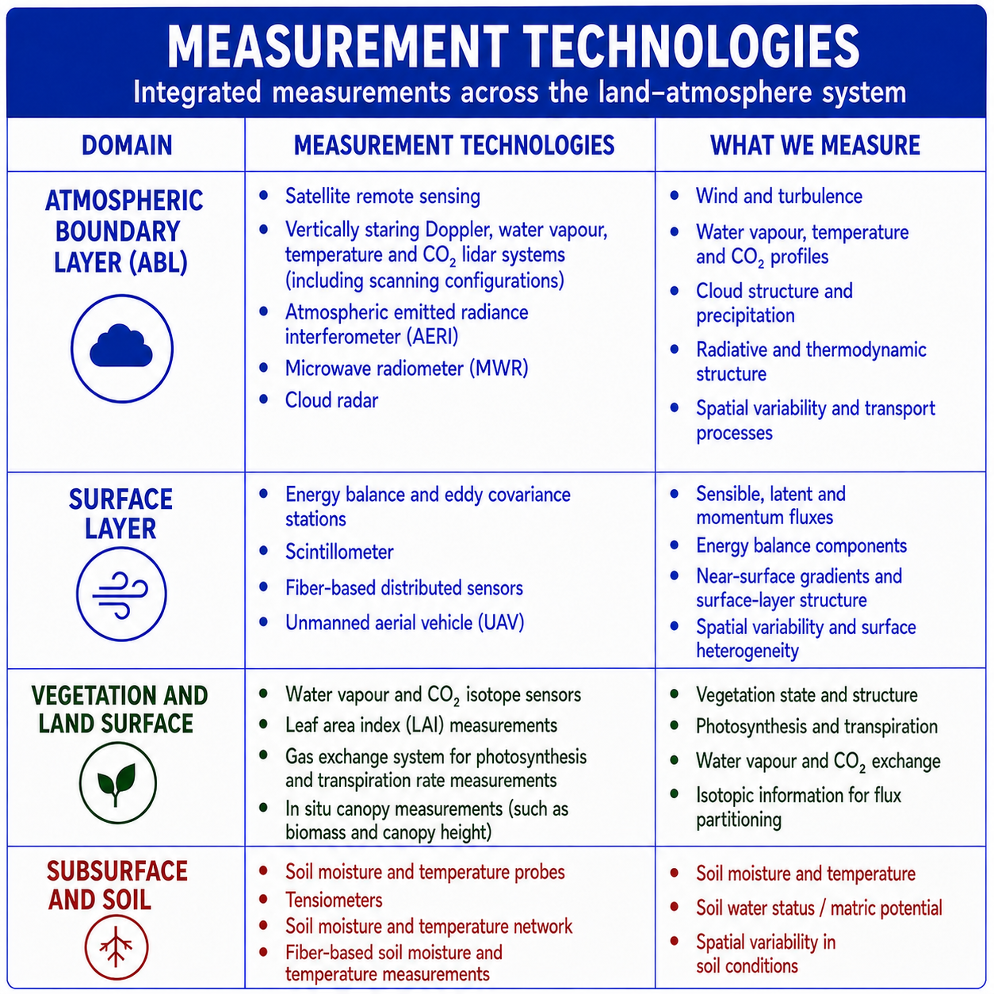
The coordinated use of complementary measurement technologies enables GLAFO to address its scientific objectives by linking observations across the full land–atmosphere system. Atmospheric profiling systems resolve the vertical structure, gradients, and evolution of the atmospheric boundary layer, while surface-layer and land-surface measurements quantify exchanges of momentum, heat, water, and carbon at the interface between land and atmosphere. Subsurface observations extend this framework below ground, capturing the storage and redistribution of water and energy that influence surface fluxes and vegetation functioning.
Used together, these technologies enable simultaneous observation of the state variables, gradients, and turbulent fluxes required to investigate land–atmosphere feedbacks across domains and scales. This integrated framework supports the characterisation of transport and exchange processes, the closure of energy and water budgets, and the development of process understanding needed to improve the representation of land–atmosphere interactions in weather and climate models, as illustrated in Figure 2.
From Measurement to Process Understanding
The strength of the GLAFO instrumentation framework lies not only in the individual systems, but in their integration. By combining measurements across domains and scales, GLAFO enables:
- Direct observation of turbulent fluxes, gradients, profiles, and transport processes.
- Characterisation of atmospheric boundary layer structure and evolution.
- Quantification of energy and water exchanges across the system.
This integrated approach provides the observational basis for improved understanding of land–atmosphere feedbacks and their representation in weather and climate models.
Scalable Observatory Design
GLAFO instrumentation follows a hierarchical and scalable design, allowing different levels of observational capability across sites. Core systems capture key exchange processes, while more advanced configurations enable turbulence-resolving measurements, budget closure, and spatial process analysis.
This approach supports both the integration of existing observatories into the network and the development of fully instrumented flagship sites.