
Mission
The mission of the GEWEX Land-Atmosphere Feedback Observatory (GLAFO) Initiative is to advance observation-based understanding of land–atmosphere feedbacks for improving Earth system modeling, weather prediction and climate projections.
Why Forecasts Fall Short
Improving the prediction of weather and climate from nowcasting to sub-seasonal to seasonal timescales remains a central challenge for the Earth system science community. Despite major advances in numerical weather prediction and climate modelling, forecast skill is still limited by an incomplete understanding and inadequate parameterization of Land-Atmosphere (L-A) feedbacks. These feedbacks, which link soil, land cover such as vegetation, and the atmospheric boundary layer through exchanges of energy, water, matter, and momentum are fundamental to the scientific evaluation and forecasting of extreme events, regional climate variability, and long-term climate change projections.
This limitation has significant consequences. Reliable representation of L-A processes is essential not only for improving forecasts of heatwaves, droughts, and precipitation, but also for increasing confidence in climate mitigation and adaptation strategies, including land-use change and bio-geo- engineering pathways. Addressing this challenge requires a step change in both process understanding and the observational basis underpinning model development.
A key barrier to progress is the lack of comprehensive, high-quality observations spanning the full L-A system. Existing observational networks often do not resolve the coupled processes across all relevant compartments, from groundwater and soil moisture, through vegetation dynamics, to the lower troposphere, nor do they provide the temporal and spatial resolution required to constrain model parameterizations.
Next-Generation Observatories for L-A Feedbacks
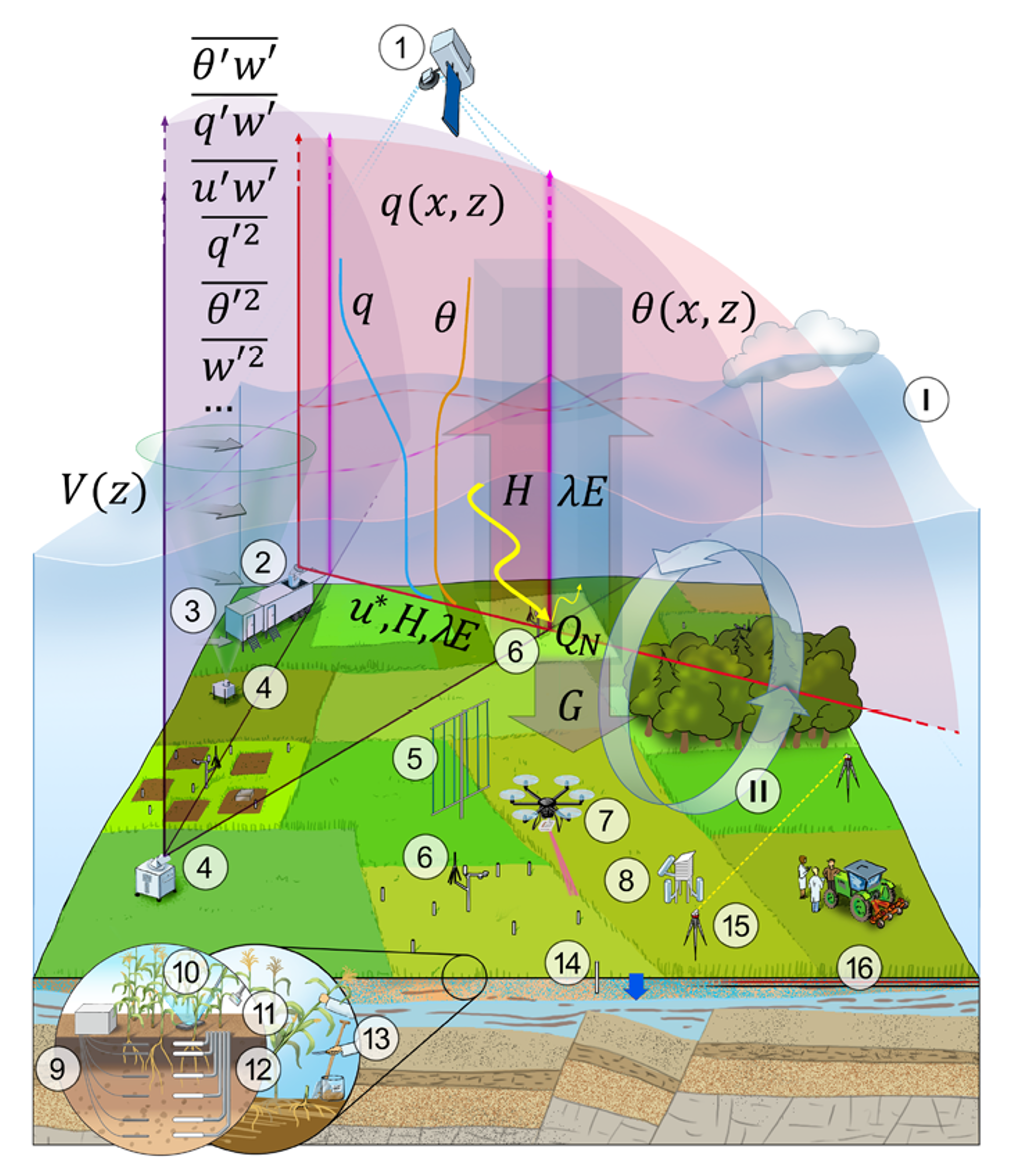
The GLAFO Initiative aims to develop a coordinated, international effort to design and implement a new generation of integrated observatories (Figure 1) enabling the delivery of sustained, high-resolution observations of L-A interactions using a harmonized data format based on the Climate and Forecast (CF) and Observations for Model Intercomparison Projects (obs4MIPs) metadata conventions.
It will create a coordinated global network of observatories across diverse climate regimes, building on existing sites such as the ARM Southern Great Plains (SGP) in the USA, Cabauw in the Netherlands, Huancayo in Peru, and Lindenberg in Germany.
This network will provide harmonized observations of land–atmosphere feedbacks to advance process understanding and improve model performance.
Documentation
- GLAFO Project White Paper – Exploring Terra Incognita in the Earth System:The GEWEX Land-Atmosphere Feedback Observatory (GLAFO)
- Wulfmeyer et al., 2020: The GEWEX Land-Atmosphere Feedback Observatory (GLAFO). GEWEX Newsletter GEWEX Quarterly, 30(1), 6-11.
1 Späth, F., Rajtschan, V., Weber, T. K. D., Morandage, S., Lange, D., Abbas, S. S., Behrendt, A., Ingwersen, J., Streck, T., and Wulfmeyer, V.: The land–atmosphere feedback observatory: a new observational approach for characterizing land–atmosphere feedback, Geosci. Instrum. Method. Data Syst., 12, 25–44, https://doi.org/10.5194/gi-12-25-2023, 2023.