
Data Management
GLAFO observatories are designed not only to generate high-quality observations, but also to deliver standardised, process-oriented data products that directly support scientific analysis and model development.
From Observations to Data Products
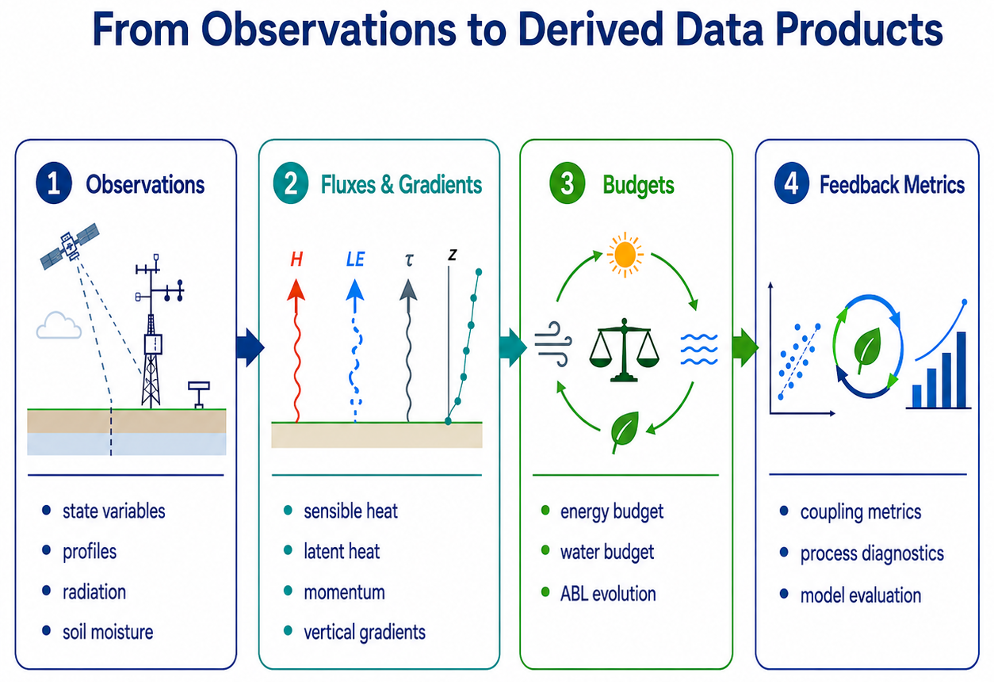
GLAFO follows a structured data framework that transforms measurements into progressively higher-level products, ranging from core observations of state variables to derived fluxes, budgets, and feedback metrics. This progression provides the basis for linking measurements across the full land–atmosphere system and turning observations into integrated process understanding (Figure 1).
Hierarchical Data Products and Derived Metrics
The level of data products generated at a GLAFO site is directly linked to its observational capability. In line with the L1–L4 observatory concept, increasing site complexity enables progressively more comprehensive coverage of the coupled land–atmosphere system and, in turn, more advanced derived products.
Core observatories can provide essential state variables, fluxes, and coupling indicators, while more advanced configurations enable turbulence-resolving profiles, budget closure, and higher-level diagnostics of land–atmosphere feedbacks. This hierarchical approach allows observatories across the network to contribute meaningful data products while supporting the development of flagship sites capable of delivering more complete process diagnostics.
Standardisation, Interoperability and FAIR Data
GLAFO data products are designed to be harmonised, interoperable, and comparable across sites. This is achieved through coordinated data structures, standardised metadata, and common approaches to documenting observations and derived products across the network.
GLAFO follows FAIR data principles to ensure that datasets are findable, accessible, interoperable, and reusable. Clear documentation, standardised formats, and complete metadata support long-term scientific use across observational, modelling, and interdisciplinary research communities.
Supporting Model Development and Evaluation
GLAFO data are explicitly designed to support Earth system modelling by providing constraints for parameterisation development, enabling evaluation of weather and climate models across scales, and supporting data assimilation and reanalysis.
By linking observations directly to model development and evaluation, GLAFO data management transforms measurements into scientific capability. This integrated framework supports improved understanding of land–atmosphere feedbacks and contributes to more robust weather and climate predictions.