
Km-scale Model Intercomparison of Cumulus Congestus and Organized Convection in GoAmazon
Contacts & leadership team: Yang Tian (NCAR), Peter Bogenschutz (LLNL), Yunyan Zhang (LLNL)
Project summary
Earth system models are entering the global storm-resolving era (grid spacing ~1-5
km), where storms are explicitly simulated and classic cumulus parameterizations is largely turned off. While km-scale models promise unprecedented realism in representing convection, precipitation, and circulation patterns, gray-zone issue at this spatial resolution persists. Some long-standing issues include the shallow to deep transition and convection organization. The Green Ocean Amazon (GoAmazon 2014/15) experiment revealed several robust diurnal modes of locally-generated deep convection (Tian et al. 2021), among which two dominant ones are: (i) a single-pulse regime with an early-afternoon peak tightly phased with surface forcing, and (ii) a double-pulse regime in which a second round of precipitation occurs with weakened surface forcing. Based on the LES study of Tian and Zhang (2025), a population of precipitating cumulus congestus was shown to moisten the middle troposphere, sustain convection under weak surface forcing, and help facilitate the upscale organization of covection later in the afternoon (Fig. 1).
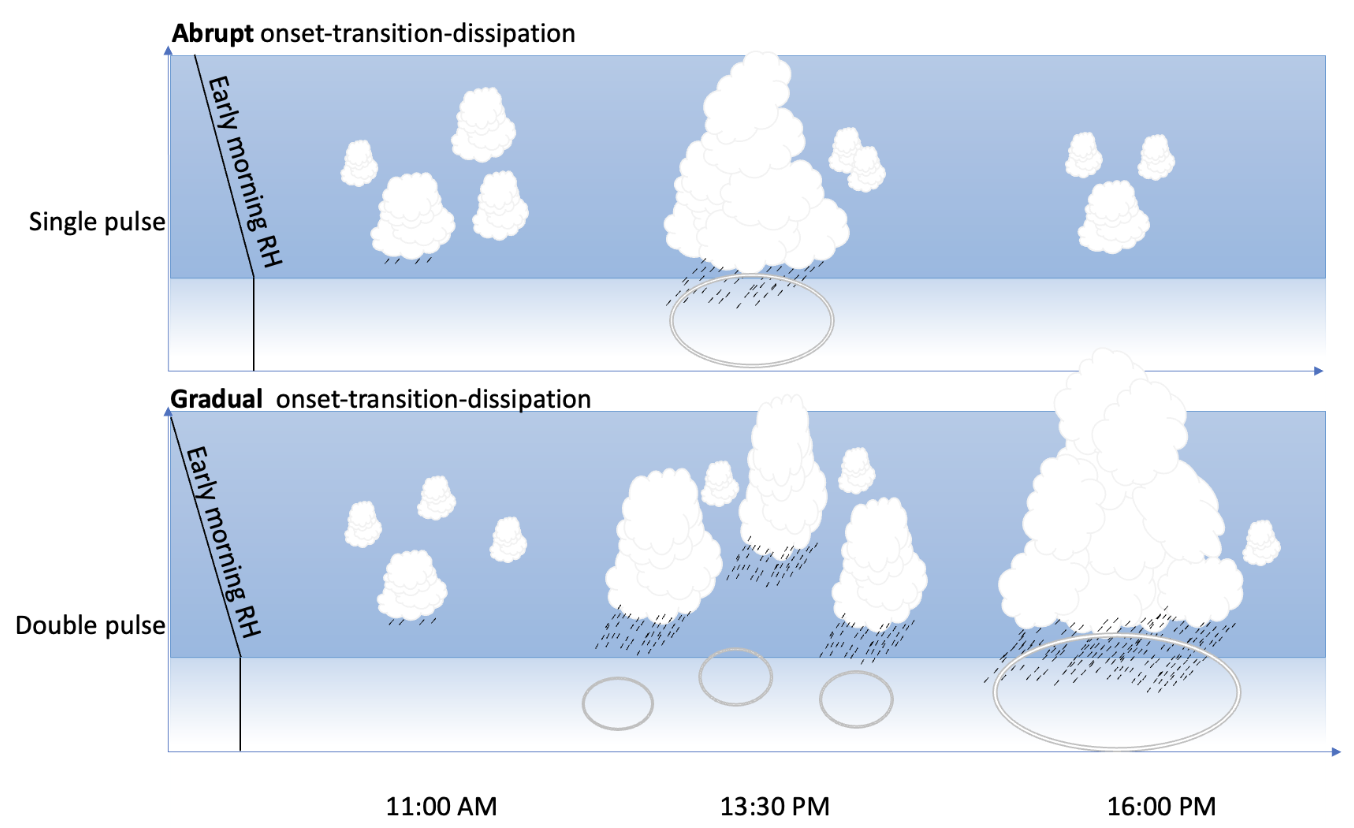
Fig 1. A schematic that demonstrates the mechanism behind single- vs double- pulse of precipitation. In single-pulse days, early morning RH is high, and the transition from shallow to deep is abrupt, whereas in double-pulse days, a slow transition that features congestus formation pre-moistens the atmosphere to allow for convection to sustain. (Tian and Zhang 2025)
In contrast, a recent process-level evaluation of a state-of-the-art km-scale SCREAM (Simple Cloud
Resolving E3SM Atmosphere Model, Caldwell et al, 2023) shows abrupt shallow-to-deep transitions and
an absence of midlevel congestus even at 250-m grid spacing, with delayed peaks and excessive ice water paths at 3 km resolution, which may result from missing or poorly represented physics that hinder realistic congestus development and cloud organization (Bogenschutz, et al. 2025). This work highlights broader issues: lack of organized tropical convection and strong sensitivity to resolution/vertical grids that impact cloud transitions.
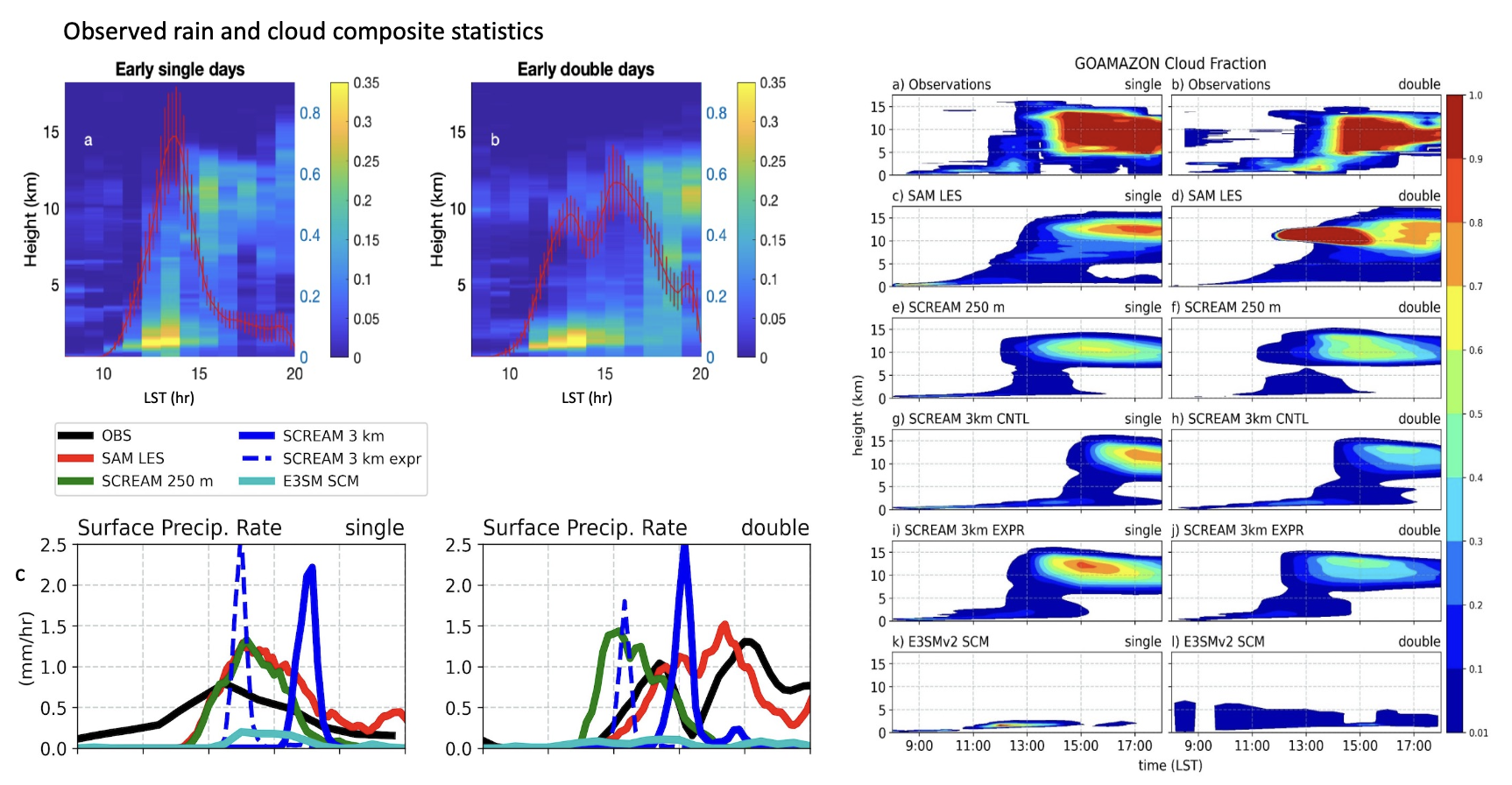
Therefore we propose to have a focused, reproducible km-scale model intercomparison centered on the
GoAmazon single- vs. double-pulse cases, which can expose where and how current CPMs/CRMs diverge from observations/LES in representing congestus and the emergence of organization, aiming to providing concrete targets for turbulence, microphysics, and gray-zone physics improvements. This intercomparison study aims to address several key scientific questions:
Key scientific questions:
- Transition dynamics: What physical pathways (resolved dynamics vs subgrid turbulence vs microphysics vs vertical resolution) govern the timing and nature (i.e. gradual vs abrupt) of the
shallow-to-deep transition? - Congestus and convective maintenance: To what extent do models reproduce the congestus stage e.g., the observed trimodal vertical cloud-fraction structure (shallow–congestus–deep) seen in GoAmazon observations and LES? Why would some models bypass congestus development?
- Organization metrics: How do models differ in their representation of the lifecycle of convective
cells, their growth, merger and dissipation and the associated size evolution and distribution? What physical processes and their representations are key for models to reproduce the convective cell
morphology and organization, e.g., turbulent mixing and transport, mid-troposphere moistening, cold-pool effects? - Environmental controls & predictability: How sensitive are the precipitation onset timing, the number of precipitation pulses, and the peak intensities to early-morning humidity and large-scale advective tendencies in different models?
Experimental design
Cases and Forcing: The intercomparison will focus on two benchmark GoAmazon days (single-pulse: 5 Oct 2014; double-pulse: 26 Aug 2015) using established variational analysis forcings (initial soundings, surface fluxes, advective tendencies) as in Tian & Zhang (2025) and Bogenschutz et al. (2025).
Models and Configurations
- Reference Large Eddy Simulation (LES): The baseline simulation will use SAM (System
Atmospheric Modeling, Khairoutdinov and Randall, 2003) at 250 m resolution over a 128 x 128
km domain, consistent with the benchmark study. - Cloud Resolving Models (CRMs) (~1–5 km), and Single Column Models (SCMs): Participating models will include a range of convection-permitting or cloud-resolving models (~1–5 km), as well as SCM configurations. Examples include SCREAM in doubly periodic mode and other km-scale
models contributed by partner institutions. Where available, groups are encouraged to include higher-resolution nested or limited-area simulations (100–500 m) to assess convergence behavior and contrast it with parameterized gray-zone responses. Though our focus will be on km-scale
model comparison, we would also welcome participation from modeling centers that are interested in contributing SCM configuration. - Configuration: All models will use doubly periodic domains with harmonized vertical grids and I/O specifications. Shared microphysics options will be used where feasible, and aerosol assumptions will be standardized to enhance comparability of microphysical responses.
Perturbation Suite: A small, diagnosis-oriented set of sensitivity experiments will accompany the baseline runs:- Vertical resolution refinement tests (coarse → fine), motivated by documented sensitivities in km-scale models.
- Targeted SGS turbulence adjustments (e.g., Bogenschutz et al. 2025) to test shallow-cloud depth and transition mechanisms.
- Controlled humidity-profile swaps in the boundary layer and mid-troposphere, reflecting LES-identified controls on pulse timing and maintenance.
- Optional additional cases, such as Colombia diurnal-precipitation events, may be included where relevant.
Participation details
All modeling centers and interested researchers are welcome to participate
worldwide. Potential participants include modeling groups from national labs, operational centers, and universities working with cloud-resolving models such as NCAR CESM/MPAS, DOE E3SM/SCREAM, WRF, and SAM.
Project timeline
This project is planned to be completed within 3 years.
- first announcement by March 31st 2026
- completion of all the simulations by May 31st 2027
- completion of all analysis and submit the paper by July 31st 2028.
Expected outcomes
- Open benchmark package: Public release of forcings, standardized namelists, and evaluation scripts, including object-tracking tools, budget diagnostics, and cloud-type attribution methods.
- Scorecards & traceable failure-modes: A set of regime-aware metrics and a “traffic-light” dashboard diagnosing congestus representation, transition sharpness, phasing, and pathways of convective organization across models.
- Process briefs: Concise per-model summaries identifying which design choices (vertical grid, SGS turbulence, microphysics, or other configuration elements) most strongly influence congestus behavior and convective organization.
- Community synthesis paper: A collaborative publication integrating results across models and recommending targeted physics improvements (turbulence, microphysics, gray-zone treatments) and vertical-grid strategies, using the GoAmazon cases as a unifying framework.
Please contact any of the team members for further inquiries or questions.