
Join us for the third webinar in the series on
ML for Benchmarking Land Models
Prof. Gab Abramowitz, UNSW
12th March 2025 | 09:30 UTC
The Machine Learning for Land Surface Models (ML4LM) webinar series gathers eminent scientists to share their experience in the combined fields of machine learning and land modeling. ML4LM aims at exploring the extent and the role that machine learning could play for better land surface studies, especially identifying the main areas where it could be applied and providing tools and data to the land surface modeling community. It is a project of the GLASS Panel, which coordinates the evaluation and intercomparison of the latest generation of land models and their applications to scientific queries of broad interest.
See the website for the registration link! Links are added a few weeks before the webinar occurs. After you register, the link for the webinar will be emailed to you.
Join us for the second webinar in the series on
Towards Flexible Interfacing of ML with Land Models
Dr. David Lawrence, NCAR
20th February 2025 | 15:30 UTC
The Machine Learning for Land Surface Models (ML4LM) webinar series gathers eminent scientists to share their experience in the combined fields of machine learning and land modeling. ML4LM aims at exploring the extent and the role that machine learning could play for better land surface studies, especially identifying the main areas where it could be applied and providing tools and data to the land surface modeling community. It is a project of the GLASS Panel, which coordinates the evaluation and intercomparison of the latest generation of land models and their applications to scientific queries of broad interest.
See the website for the registration link! Links are added a few weeks before the webinar occurs. After you register, the link for the webinar will be emailed to you.
Join us for the first webinar in the series on
Advances in Machine Learning for Earth System Modeling
Dr. Peter Dueben, ECMWF
20th January 2025 | 15:00 UTC
You can view a recording of the webinar here: https://youtu.be/RpFTJ6b8-xg.
The Machine Learning for Land Surface Models (ML4LM) webinar series gathers eminent scientists to share their experience in the combined fields of machine learning and land modeling. ML4LM aims at exploring the extent and the role that machine learning could play for better land surface studies, especially identifying the main areas where it could be applied and providing tools and data to the land surface modeling community. It is a project of the GLASS Panel, which coordinates the evaluation and intercomparison of the latest generation of land models and their applications to scientific queries of broad interest.
Registration for January’s webinar is closed. See the webinar series webpage for a list of upcoming webinars and active registration links.
The Committee on Space Research (COSPAR) is proud to announce the COSPAR 2025 Scientific Symposium in cooperation with the Cyprus Space Exploration Organisation (CSEO).
This Symposium, themed “Space Exploration 2025: A Symposium on Humanity’s Challenges and Celestial Solutions”, will delve into critical global challenges such as climate change, resource depletion, and space weather, while exploring how space exploration and technology can offer solutions. It will present various matters related to ongoing and planned space programs, fostering discussions on international collaboration, ethical considerations, and the role of emerging nations in space exploration.
For detailed information visit https://cospar2025.org
This interdisciplinary event brings together researchers, policymakers, and stakeholders to explore the multifaceted dynamics of the Baltic Sea and its catchment, examining the rich history, current functioning, and future prospects of this region. Over the course of the conference, critical topics will be visited across seven thematic sessions covering a wide range of disciplines and addressing fundamental scientific problems and environmental challenges. By fostering interdisciplinary dialogue and international collaboration, the aim of this congress is to generate innovative solutions to preserve and protect the unique marine environment of the Baltic Sea for generations to come. Join this event to share your knowledge, insights, and strategies to ensure a sustainable future for this vital ecosystem.
Themes
- Physical and Biogeochemical Changes in the Baltic Sea
- Ecosystem Health and Biodiversity
- Geological Processes and Coastal Erosion
- Land-Ocean-Atmosphere Interactions and Catchment Processes
- Marine Pollution: Sources, Trends, Effects and Solutions
- Exploitation of ecosystem services and its impact on the Baltic Sea ecosystem
- Emerging Technologies for Research and Monitoring
Important dates
| Call for abstracts | : 10 December 2024 – 21 February 2025 |
| Registration period | : 15 January – 14 April 2025 |
| Early Bird registration deadline | : 31 March 2025 |
| 2025 Baltic Sea Science Congress | : 26 – 30 May 2025 |
Please visit the official meeting website at http://www.bssc2025.pl/
The Eighth WMO International Workshop on Monsoons (IWM-8) will focus on Advancing the Understanding & Prediction of Monsoons and their Impacts in a Changing Climate and will emphasize addressing monsoon impacts as part of the societal challenges prioritized by the WWRP and WCRP.
The workshop will be held at IITM Pune during 17-21 March 2025 in hybrid mode, permitting on-site and virtual participation. The IWM provides a forum for researchers, forecasters, and stakeholders/end-users to discuss recent advances in monsoons research and current topics including new observational studies, process studies, and strategic priority setting for modelling/prediction studies, covering weather-to-climate time scales. The emphasis is on addressing monsoon impacts as part of the societal challenges prioritized by the WWRP and WCRP: high-impact weather, water, agriculture, energy, disaster risk reduction, urbanization, and new technologies, in heavily populated monsoon regions around the world. Outcomes from the workshop are expected to facilitate transfer of new science and technology to National Meteorological and Hydrological Services (NMHSs) in these regions.
For more information, please visit the workshop website.
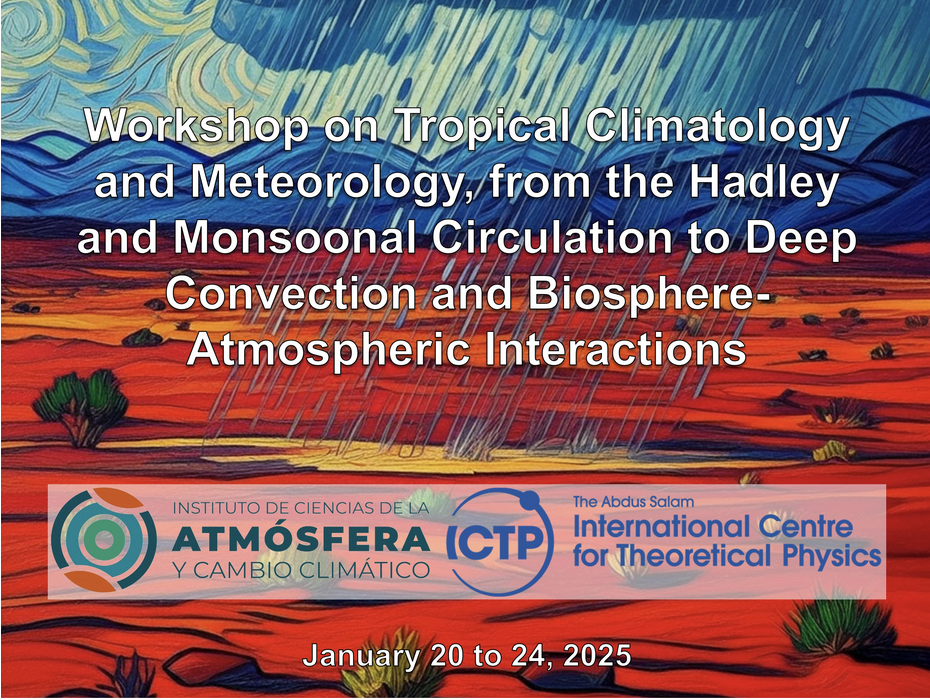
The Workshop Tropical Climatology and Meteorology from the Hadley and Monsoonal Circulation to Deep Convection and Biosphere-Atmospheric Interactions will enhance the understanding of the tropical climate and meteorology and their connection to atmospheric convection.
Participants will attend seminars focusing on fundamental scientific issues that are central to the study of the tropics. Additionally, they will engage in a two-day intensive course where they will conduct data analysis and modeling activities relevant to tropical studies. To receive a diploma, participants should attend all activities and present a group project.
Workshop Topics
- Convection and its organization
- Modern theories of monsoons
- Focus on the North American Monsoon
- Monsoons and climate modeling (seasonal forecasts and CMIP6 models)
- Tropical waves
Detailed information about the program and speakers is available at https://www.gewex.org/gewex-content/uploads/2024/11/Poster_workshop-ICTP.pdf.
For in-person participation, please register here.
Online participation in real-time is also possible via Facebook and YouTube.
The GEWEX Data and Analysis Panel (GDAP) was organized to bring together theoretical and experimental insights into the radiative interactions and climate feedbacks associated with cloud processes. The central question that governs the GDAP mission is: “how sensitive is the Earth’s climate to changes in radiative and other forcings?” Answering this question will enable improved prediction of transient natural climate variations, such as El Niño, and provide better understanding of the consequences of natural and human-induced climate changes.
During 2025 GDAP meeting, participants will evaluate the progress of current GDAP assessments and projects. They will also engage in discussions regarding potential collaboration and explore new project opportunities. As one of the four panels of the Global Energy and Water Cycle Exchanges (GEWEX), a core program of the World Climate Research Program (WCRP), the GEWEX Science Questions and the WCRP Lighthouse activities will be at the heart of these discussions.
The 2025 GDAP meeting is planned to take place in conjunction with the Upper-Tropospheric Clouds and Convection (UTCC) Process Evaluation Study (PROES) meeting.
Participation is for Panel members and invited guests only.
For additional information visit https://www.gewexevents.org/meetings/2025gdap/
The GEWEX Hydroclimatology Panel (GHP) concentrates on improving our understanding of environmental water and energy exchanges at the regional scale and from an integrated perspective. Addressing the water cycle at the regional scale allows us to better understand the many components of the system, from its physical to economic to social aspects.
This year’s meeting will be used to review the state of the current ongoing actions (RHPs, CCs, Networks and the links with the Data Centers). GHP members and project leads will evaluate ongoing and planned GHP activities and asses future actions to ensure that the Panel contributes effectively to the leading role that GEWEX plays in the hydrological and climate sciences and related modeling activities.
Note that this meeting is by invitation only.
For additional information visit https://www.gewexevents.org/meetings/2025ghp/
The international conferences in IGWC series are the meeting point for groundwater professionals and researchers, bringing together experts in the various inter-related disciplines in the field of Groundwater Hydrology. Groundwater has emerged as a major resource in safe guarding agriculture and drinking water security in many parts of the globe.
The role of groundwater in contributing to water security and searching solutions for its conservation and sustainable management at present will play a crucial role to meet water demands of the population in future under a changing climate and to ensure food and water security for both the developed and developing countries. Towards a Water-Secure Future: The aim of IGWC 2025 is to provide a common platform for researchers, academicians, water managers, industrialists and technocrats to discuss and deliberate the groundwater vision 2047 in the face of growing challenges of the needs of rising earth population and confronting climate uncertainties in water resources planning and management.
For more information visit https://igwc2025.nihroorkee.gov.in/index