
The 7th WGNE Workshop on Systematic Errors in Weather and Earth System Models (SEW2027) aims to bring together a wide range of experts on simulating the Earth System including atmosphere, ocean, waves, land-surface, atmospheric composition, and associated disciplines to advance the understanding of systematic simulation errors at all timescales. A summary paper will document key findings and identify priority biases in Earth System Models (ESMs).
Of interest are abstract submissions on systematic errors in physics based or machine learning based models, of all components of the Earth System including coupled and individual component models. In broad, submissions can be made under one of these 6 topics. These topics invite contributions that help to increase understanding of the nature and cause of systematic errors in ESMs.
Science Topics include:
- Diagnosing and Attributing Systematic Errors
- Scale Interactions and Resolution Transitions
- Deficiencies in physical parameterisation
- Coupled Earth System Feedbacks
- Impacts on Circulation, Variability, and Predictability
- Uncertainty and Ensembles
The 5th International Soil Modeling Consortium Conference (ISMC 2026), “Advances and Challenges in Tropical Soil Modeling,” will take place from 15–19 September 2026 in Rio de Janeiro, Brazil, hosted on site at Pontifical Catholic University of Rio de Janeiro (PUC-Rio). The conference is organized by the University of São Paulo (USP), the Geological Service of Brazil (SGB), and PUC-Rio.
ISMC 2026 will focus on tropical soil modeling, emphasizing its importance for food and water security, carbon cycling, biodiversity, and land-use change. The conference will showcase how soil models integrate field and laboratory data, remote sensing, and monitoring networks to support hydrological forecasting, agricultural management, land-use planning, and climate-change adaptation.
Themes
- Databases in PTF development to support soil modeling
- Soil structure and properties: Measurement, spatial and temporal variability, and uncertainty assessment
- Integrating soil and crop modeling
- Critical zone monitoring and modeling
- Modeling processes in highly weathered tropical soils
- Taking advantage of remote sensing and big data in soil modeling
- Modeling aspects of soil health
- General Session for model-related research
For detailed information visit https://ismc2026.com.br
The International School on Satellite Meteorology (ISSM) aims to train the next generation of scientists and operational meteorologists to consider remote measurements from space as a key point for understating and modeling meteorological phenomena. ISSM training school is focused on Satellite Meteorology as the study of the atmospheric, land, and oceanic systems using remotely sensed data from different sensors onboard meteorological satellites. The basic principles of satellite remote sensing of weather features connected to microphysics of clouds and precipitation is treated, as well as the fundamentals of retrieval methods, AI-based architectures, advanced techniques for satellite imagery interpretation and satellite products for science and operational meteorology. High Performance Computing (HPC) for numerical weather forecast, quantum technologies and digital twins of the Earth system (DestinE) are key topics of the school. A special focus will be swept to the sensor technology and satellite mission development, launch, and in-orbit management.
The ANDEX Annual Meetings represent one core activity of the program, and this year this event will take place at the Universidad de Cuenca, between 20–24 July 2026. The aim is to bring together the members of the ANDEX community as well as collaborators working on the different Andean countries. Also anticipated, is a vibrant participation of members of JovenANDEX, a network created to incorporate the vision, needs and activities of early career scientists within the ANDEX program.
For more information visit https://www.gewexevents.org/meetings/2026andex/.
The Working Group on Numerical Experimentation (WGNE) will organise the 7th hybrid Workshop on Systematic Errors in Weather and Earth System Models, to be hosted by the Indian Institute of Tropical Meteorology (IITM) in Pune, India on 15th-19th February 2027.
The workshop aims to bring together a wide range of experts on simulating the Earth System including atmosphere, ocean, waves, land-surface, atmospheric composition, and associated disciplines to advance the understanding of systematic simulation errors at all timescales. A summary paper will document key findings and identify priority biases in Earth System Models (ESMs).
Science Topics
- Diagnosing and Attributing Systematic Errors
- Scale Interactions and Resolution Transitions
- Deficiencies in physical parameterisation
- Coupled Earth System Feedbacks
- Impacts on Circulation, Variability, and Predictability
- Uncertainty and Ensembles
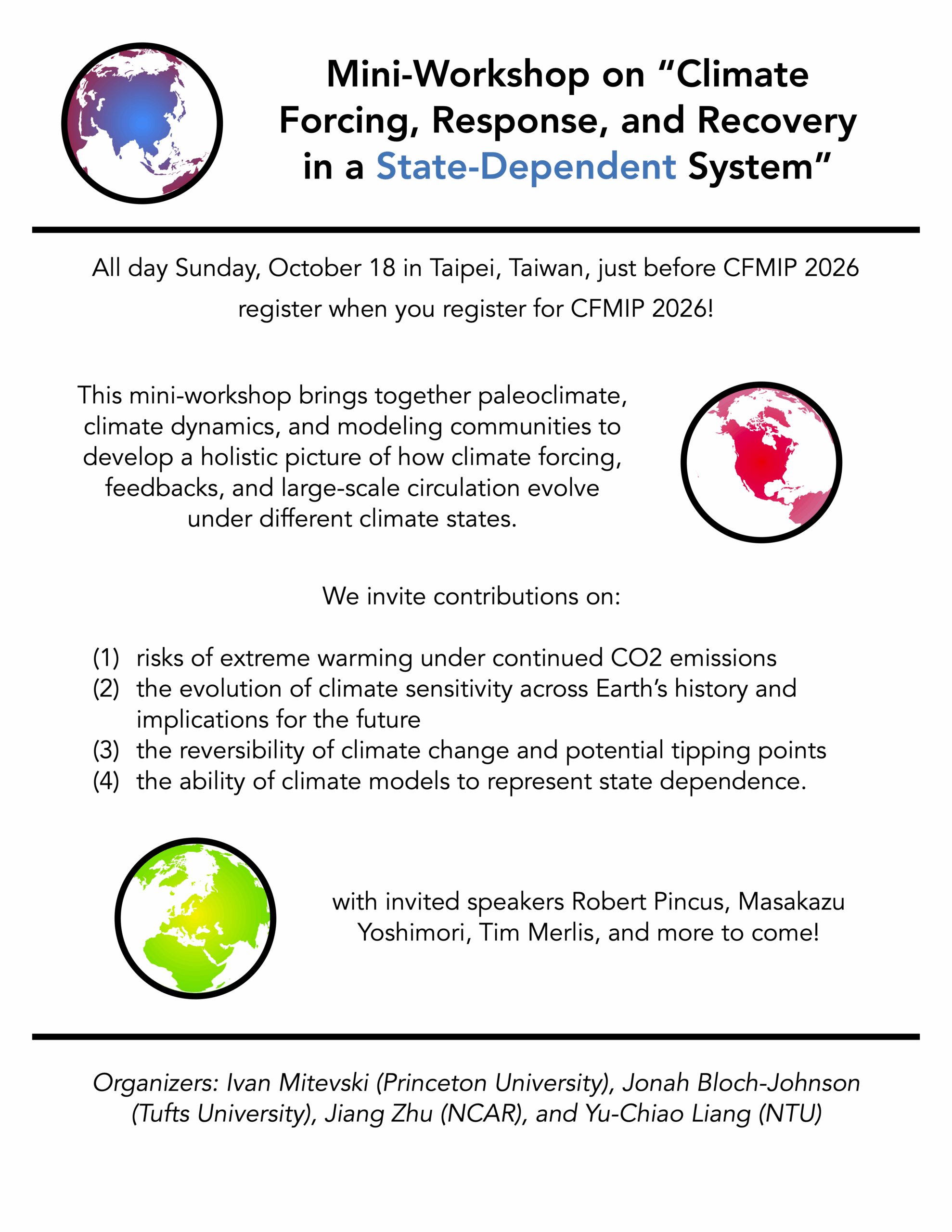
The 2026 Cloud Feedback Model Intercomparison Project (CFMIP) Meeting on Clouds, Precipitation, and Circulation will feature oral and poster sessions on the following topics. Contributions may include perspectives from observations, models spanning a range of resolutions and complexities, and theoretical frameworks:
-
Forcing, Feedbacks, and Climate Sensitivity
-
Earth’s Energy Imbalance
-
Convective Processes and Convective Organization
-
Micro- to Meso-scale Cloud Processes
-
Coupling of Clouds with Atmospheric and Oceanic Circulation
-
Hydrological Cycle and Regional Precipitation
For additional information, visit https://sites.google.com/view/cfmip2026/home
This meeting is a follow-on to the 2025 summer workshop and will focus on the role of land–atmosphere interactions in predictability at subseasonal-to-seasonal (S2S) timescales (here defined as two weeks to three months). Building on last year’s outcomes, the workshop will bring together researchers, modelers and practitioners working on:
- Process-oriented metrics for evaluating land–atmosphere interactions in S2S models
- Application-oriented metrics to assess user-relevant aspects of S2S prediction
- Experimental protocols for coordinated S2S land–atmosphere experiments
- Demonstrations and early results applying these metrics and protocols in S2S modeling systems
- Community regionally refined simulations
- Applications of S2S forecasts to agriculture, water resources, wildfire, heatwave, extreme rainfall, and more
The program will include a mix of science and applications talks, working-group showcases, discussion of coordinated experiments, and planning for future community efforts.
For Additional information, registration and abstract submission visit https://ncarprojects.ucar.edu/S2S-predictability/2026-s2s-land-atmosphere-interactions-workshop
Unifying Innovations in Forecasting Capabilities Workshop 2026 (UIFCW26) is an opportunity for community partners, across academia, industry, and government, to collaborate in the shared mission to advance forecasting capabilities. The theme for this year’s workshop is a New Frontier: Optimizing New Technology in a Changing Weather Enterprise. Objective of this workshop is to strengthen the understanding of the collaborative efforts to improve the Unified Forecast System (UFS), accelerate meaningful contributions, and measure progress more effectively.
Focus will continue on integrating sectors of the Weather Enterprise and fostering a community aligned with the mission of the Earth Prediction Innovation Center (EPIC), emphasizing government research and the crucial role of community building. UIFCW26 is dedicated to engaging and uniting efforts to advance forecasting capabilities for a more informed future.
For information and to register, visit https://epic.noaa.gov/eventsposts/uifcw-2026/
The central question that governs the GEWEX Data and Analysis Panel (GDAP) mission is: “how sensitive is the Earth system to changes in radiative and other forcings?” Answering this question will enable improved prediction of transient natural variations, such as El Niño, and provide better understanding of the consequences of natural and human-induced Earth system changes.
The annual GDAP Meeting (by invitation only) is organized to bring together theoretical and experimental insights into the radiative interactions and Earth system feedbacks associated with cloud processes. During this meeting, participants, including panel members and invited local speakers, will evaluate the progress of the ongoing GDAP evaluations and projects and engage in discussions regarding potential collaboration and explore new project opportunities.